Wednesday, November 11, 2009
Speak Up Survey
We are developing our Information and Technology Literacy Plan for 2010-2013, and are using a national online survey called Speak Up 2009 to get input from students and parents. The data will be aggregated nationally and presented in a Congressional Briefing, and we'll be able to see the data for each school to help us plan. Please take the anonymous survey at http://www.speakup4schools.

Thursday, November 5, 2009
Troubleshooting email notification delays
We have received word that some parents are not receiving email notifications from the district in a timely manner, or not at all. Right now, this is mainly affecting parents who have a Yahoo! email address, but from time to time we encounter this with various ISPs and email providers.
If you are not receiving email notifications from the Oregon School District, including newsletters, attendance alerts, low lunch balance notifications, etc., try these tips.
Tip #1
Call the school secretary and verify your email address is listed correctly in PowerSchool. Many errors are due to an out-of-date email address or a typo.
Tip #2
Please add mailer@notify.oregon.k12.wi.
Tip #3
Contact your email provider. Tell them you are not receiving email messages from mailer@notify.oregon.k12.wi.us and ask them to whitelist that address.
FAQ
Why is this happening?
The district sends large bursts of email to notify parents of low lunch balances or to send newsletters. Some Internet service providers and email providers see this large burst of mail and incorrectly classify it as "spam."
Who is affected?
In the past, this has happened with Verizon, and currently we see that Yahoo! puts our email messages on a "deferred" list, meaning they are not delivered until days after being sent. Unfortunately, it is impossible to anticipate and mitigate every email provider's spam-preventation errors.
What is the district doing to fix this?
When an issue like this comes to our attention, we check our mail logs to find the problem, and contact the ISP or email provider to find a solution. In addition, we are developing ways to queue our email to send out a few messages at a time rather than a ton of them at once.
What should I do if none of the tips work?
Parents should get in the habit of checking their child's school lunch balance regularly on PowerSchool. While email notification is convenient, it is also not completely reliable.
If you are not receiving email notifications from the Oregon School District, including newsletters, attendance alerts, low lunch balance notifications, etc., try these tips.
Tip #1
Call the school secretary and verify your email address is listed correctly in PowerSchool. Many errors are due to an out-of-date email address or a typo.
Tip #2
Please add mailer@notify.oregon.k12.wi.
Tip #3
Contact your email provider. Tell them you are not receiving email messages from mailer@notify.oregon.k12.wi.us and ask them to whitelist that address.
FAQ
Why is this happening?
The district sends large bursts of email to notify parents of low lunch balances or to send newsletters. Some Internet service providers and email providers see this large burst of mail and incorrectly classify it as "spam."
Who is affected?
In the past, this has happened with Verizon, and currently we see that Yahoo! puts our email messages on a "deferred" list, meaning they are not delivered until days after being sent. Unfortunately, it is impossible to anticipate and mitigate every email provider's spam-preventation errors.
What is the district doing to fix this?
When an issue like this comes to our attention, we check our mail logs to find the problem, and contact the ISP or email provider to find a solution. In addition, we are developing ways to queue our email to send out a few messages at a time rather than a ton of them at once.
What should I do if none of the tips work?
Parents should get in the habit of checking their child's school lunch balance regularly on PowerSchool. While email notification is convenient, it is also not completely reliable.
Monday, October 12, 2009
PowerSchool feature update
PowerSchool will be unavailable on Wednesday, October 14, 7-8 PM, for a version upgrade.
In addition to some important bug fixes, the upgrade has one significant improvement for parents: the parent portal will show exactly what teachers have entered in the grade book. For example, if a teacher marks an assignment as an "M" for missing, or "L" for late, it will show up for parents to see.
In addition to some important bug fixes, the upgrade has one significant improvement for parents: the parent portal will show exactly what teachers have entered in the grade book. For example, if a teacher marks an assignment as an "M" for missing, or "L" for late, it will show up for parents to see.
Wednesday, September 30, 2009
Safe computing- Free anti-virus for Windows
Microsoft has just released a free anti-virus product called Security Essentials for Windows computers. Almost everyone knows that they should have anti-virus software installed, but not everybody does it. If the cost was keeping you from buying anti-virus software, this free version could be just what you need.
See http://www.microsoft.com/security_essentials/
See http://www.microsoft.com/security_essentials/
Wednesday, July 29, 2009
What is Web 2.0?
What is "Web 2.0?"
I get this question fairly often, usually in a timid, apologetic voice, as if it must surely be obvious to everyone else on the planet. Not really.
Here are a few quick answers.
First, according to a survey of Web 2.0 use sponsored by the MacArthur Foundation, CoSN, ASCD, and the Metiri Group:
Second, a video by Michael Wesch demonstrates the evolution of the Web into the participatory media that is described above.
Third, the Wikipedia entry, which has a decidedly business-oriented and chronological point of view:
Finally, a word cloud illustration that accompanies the Wikipedia article.

Some people have already started talking about "Web 3.0," but I think that's really overshooting the hype tolerance of most people. Let's just work on getting everybody using Web 2.0 first, shall we?
I get this question fairly often, usually in a timid, apologetic voice, as if it must surely be obvious to everyone else on the planet. Not really.
Here are a few quick answers.
First, according to a survey of Web 2.0 use sponsored by the MacArthur Foundation, CoSN, ASCD, and the Metiri Group:
Definition of Web 2.0
For the purposes of this survey, Web 2.0 applications use the World Wide Web (WWW) as a platform and allow for participatory involvement, collaboration, and interactions among users. Web 2.0 is also characterized by the creation and sharing of intellectual and social resources by end users. Examples of Web 2.0 applications are web logs or “blogs”; online diaries that allow the owner to state ideas and opinions and readers to react; WIKIS, collections of information on topics that can be edited by a group such as Wikipedia; and social networking sites (e.g., Facebook) where users can create personalized pages of information and interact with others.
Second, a video by Michael Wesch demonstrates the evolution of the Web into the participatory media that is described above.
Third, the Wikipedia entry, which has a decidedly business-oriented and chronological point of view:
The term "Web 2.0" describes the changing trends in the use of World Wide Web technology and web design that aim to enhance creativity, communications, secure information sharing, collaboration and functionality of the web. Web 2.0 concepts have led to the development and evolution of web-culture communities and hosted services, such as social-networking sites, video sharing sites, wikis, blogs, and folksonomies. The term first became notable after the O'Reilly Media Web 2.0 conference in 2004.[1][2] Although the term suggests a new version of the World Wide Web, it does not refer to an update to any technical specifications, but rather to changes in the ways software developers and end-users utilize the Web. According to Tim O'Reilly:
Web 2.0 is the business revolution in the computer industry caused by the move to the Internet as a platform, and an attempt to understand the rules for success on that new platform.[3]
Finally, a word cloud illustration that accompanies the Wikipedia article.
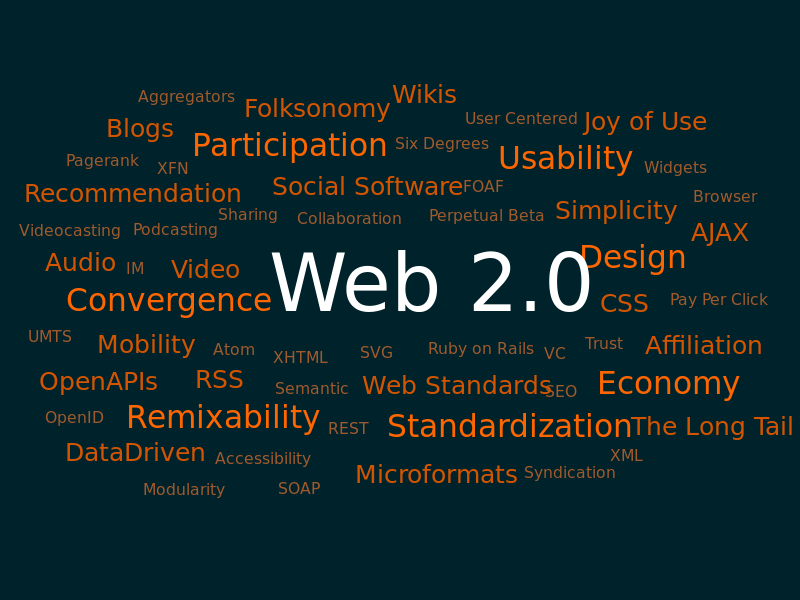
Some people have already started talking about "Web 3.0," but I think that's really overshooting the hype tolerance of most people. Let's just work on getting everybody using Web 2.0 first, shall we?
Monday, June 29, 2009
Comprehensive Text Message Glossary
Have you ever wondered how kids can text so quickly? In part, it's because they use abbreviations of most common words and phrases. Many of these abbreviations originated in Instant Message (IM) programs and are now used in text messages.
Webopedia has a fairly comprehensive dictionary of common text message abbreviations. Most of the objectionable terms have been substituted by more "palatable" words, so you may have to use your imagination to get the real meaning of some of them.
You can view the list here.
Webopedia has a fairly comprehensive dictionary of common text message abbreviations. Most of the objectionable terms have been substituted by more "palatable" words, so you may have to use your imagination to get the real meaning of some of them.
You can view the list here.
Tuesday, June 9, 2009
Protecting Students in the 21st Century
SimpleK12.com provides free web-based resources for teachers and parents to use while teaching students how to make wise decisions when using the Internet and cell phones.
Oregon School District does not endorse SimpleK12, but is providing this as an informational resource.
Spread the Word! Internet and Cell Phone Safety from InfoSource Learning on Vimeo.
Oregon School District does not endorse SimpleK12, but is providing this as an informational resource.
Spread the Word! Internet and Cell Phone Safety from InfoSource Learning on Vimeo.
Tuesday, March 24, 2009
Online safety for elementary parents
Have you set the parental controls on your family’s game console? Are the games age-appropriate? Do you know who your kids chat with while gaming online?
If you’re not sure how to protect your family from cyberbullies, scammers, and predators while they game, follow these gaming tips from the safety experts at NetSmartz® Workshop and Microsoft’s® GetGameSmart.
Visit NetSmartz.org to download the gaming safety flyer. Also check out the new NSTeens online gaming piece, launching on April 1st.
If you’re not sure how to protect your family from cyberbullies, scammers, and predators while they game, follow these gaming tips from the safety experts at NetSmartz® Workshop and Microsoft’s® GetGameSmart.
Visit NetSmartz.org to download the gaming safety flyer. Also check out the new NSTeens online gaming piece, launching on April 1st.
Monday, March 16, 2009
Teens and texting
Do you know what your child is texting?
According to a study by the National Campaign to Prevent Teen and Unplanned Pregnancy entitled "Sex and Tech: What's Really Going On,"
Not to sound alarmist, but this is something that parents should be aware of, and should discuss with their children. Here are some helpful tips for parents (PDF) and guidelines for teens (PDF) from the National Campaign.
You can read a summary of the full study here (PDF).
According to a study by the National Campaign to Prevent Teen and Unplanned Pregnancy entitled "Sex and Tech: What's Really Going On,"
21% of teen girls and 18% of teen boys have sent/ posted nude or semi-nude images of themselves.
Not to sound alarmist, but this is something that parents should be aware of, and should discuss with their children. Here are some helpful tips for parents (PDF) and guidelines for teens (PDF) from the National Campaign.
You can read a summary of the full study here (PDF).
Subscribe to:
Posts (Atom)